On Planning
Or the subtle art of not giving a f*** about the plot.

It’s been years since I read On Writing by Stephen King, but I kind of remember that he scoffed at the whole concept of writing as some noble and mysterious craft and argued it’s only about grit and butt muscles.
I’m definitely not Stephen King, and I don’t try to argue anything. But I know from my preferences. More than the plot, I’m pulled into the story by its characters, how they are challenged to better themselves, the clarity of the writing, and how well I can visualize everything in my mind.
My challenge: I’m a discovery writer. Or (what some mean people call it) a “pantser”.
Pantser vs Plotter
I won't go into details here. In any case, most people know what these mean. Either someone who plans and outlines everything, or someone who kind of lets writing lead them to the end.
As with all things, none of us is black-and-white “something.”
‘Who I am’ is a shifting concept, transmuting as I grow and change. The more I’ve been writing, the more I’ve learned and consequently adjusted my approach, especially when I’ve noticed they don’t work anymore.
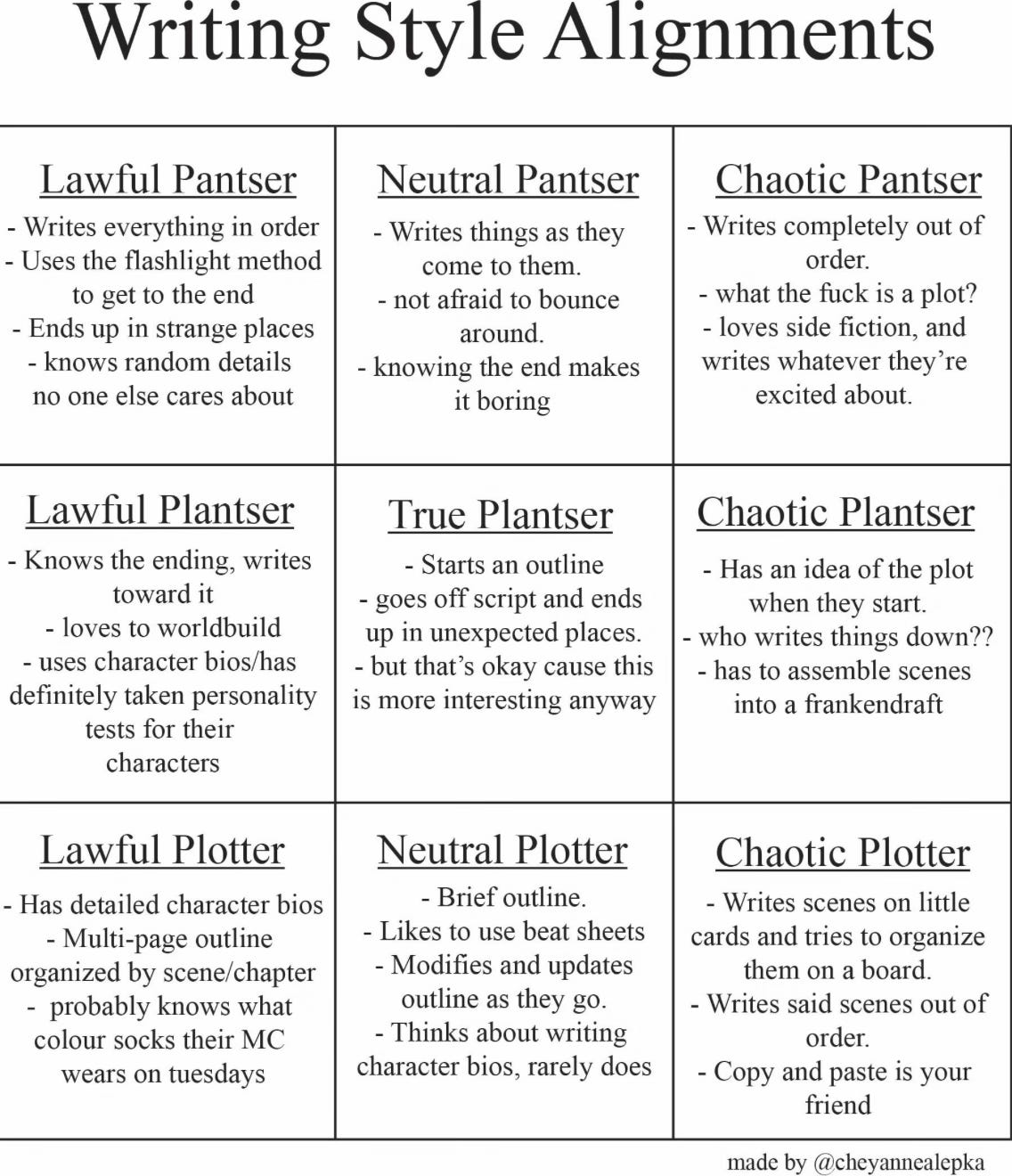
I like to generate overall plot points, identify the “call to adventure,” “midpoint,” and so forth. Also, I spend a lot of time developing the characters and their background. I still don’t want to draw the complete outline, nor do I want to write the ending. I usually have a clear idea of how the story will end, but I’ve rushed too often to start too soon.
I love the excitement of following the story. It feels as though the story is a forest, offering a multitude of paths, each leading to the same place but with different flavors: darkness and excitement, easy walks and boredom, and sometimes I’m not even sure what I’m going to find.
So, it shouldn’t be a surprise to anyone if I confess that, until this year, I rarely put a lot of effort into scene-level planning, thinking it was too constraining. Instead, I wrote each chapter in one go.
It didn’t always work out well, and it often meant I got stuck in one chapter, expecting myself to flesh it out fully before moving forward. Or, annoyingly often, I needed to go back and fix it because it no longer worked conceptually.
Not a very useful approach, I’ve come to realize.
Instead, nowadays, since I often have a general idea of what the chapter will be about, I’ll start outlining it loosely and then fill it in. It allows me a chance to move forward and work on multiple scenes a bit sneakily.
How it works in practice.
This is an example of a story I just started outlining. The original idea stems from my early 20s. I’ve kept most of my unfinished stories and dabbles and peruse them for possible inspiration (here’s also a topic for another time, so I’ll just leave it there). This story is in early formation. I’m only now starting to refine the main character and her challenges.
The first sample is my raw sketch. The second a polished one. You will see the difference.
Sample (when I had just outlined the scene):
[Starts at the Anchorage, Mister Dewaele’s office.]
Celia sat across from a well-dressed, affluent man around forty. In the corner was an elderly woman. After having Mister Dewaele’s servant pour them tea, which she strongly suspected was spiced with something more special, the elderly woman had promptly fallen asleep. Her snoring now echoes in the background.
Mister Dewaele leaned back in his chair, single dark brow arched. “When was it the last time we saw, Miss Trevasia?”
She lifted the porcelain cup to her lips. Too bad the special spices seemed to be reserved for elderly ladies. She’d appreciated something stronger than mere tea to swallow the fact that she was sitting across from Mister Henrik Dewaele.
She smiled. “Oh, I’m not sure. You know how time goes by, Mister Dewaele. Surprising as it may seem, I find myself less patient with unpleasant ones.”
A flash of anger, his mouth tightening.
[Environmental beat – sunlight, shouts at the harbor.]
Celia lowered her cup. “Mister Dewaele, you are a businessman. You understand the concept of time. Please respect mine and tell me why you wanted to see me.”
Ok, I unfortunately don’t keep copies of the barest bone examples as my files are living documents. But as it happens, I moved the text to my writing program. (I use Scrivener. Here’s my unpaid sales speech: If you’re a writer in search of writing tools, look no further!)
I’d argue that the example above is already pretty fleshed out. I haven’t added too many environmental cues, nor have I laced it with sensory details, but anyone should get a general understanding of what happens and who the characters are.
But since we’re talking about writing as a craft, and to drive the point home. After that, I worked a bit more on my characters and plot beats, and came up with this.
A (more) polished version of the same scene
The stately clock in the corner ticked the time away, a steady rhythm of snoring chasing its pace. Beyond the latticed windows spread the eastern harbors of Corleubruug and ships with tacked sails, workmen and officers mingling on piers.
Celia shifted in her chair, casting a sideways glance at the corner. An elderly woman in a dark dress slouched there, a drop of drool suspended from her wrinkled mouth.
She sighed.
The servant pouring their tea must have laced her chaperone’s with something extra. The woman had promptly fallen asleep not long since. The low purr of her snore echoed in the quiet room.
How vexing. If the woman wasn’t awake by the time Celia was ready to leave, she’d tell her host to deal with it. In his impeccable dark suit and necktie, the auburn-haired Mister Henrik Dewaele leaned in his chair and raised a brow.
“It seems my chaperone was more tired than she let on.” Celia lifted the porcelain cup to her lips. Bergamot and orange blossom. Her mouth quirked. It seemed that special spices were reserved only for the elderly ladies.
Light glinted on his spectacles as he inclined his head to sip his tea. “It’s been some time since we last saw each other, Miss Trevasia, isn’t it?”
Tick-tock, said the clock.
Celia lowered her cup, refusing to fidget in her faded muslin gown. “Mister Dewaele, you are a businessman. You understand the concept of time. Please respect mine and tell me why you wanted to see me.”
I’m still drafting the story, so I’m not sure how much of this will remain unchanged, but… anyway.
How about you? How do you approach scene structuring? Do you do something similar?
Let me know!
And if you read all the way here—thank you!